
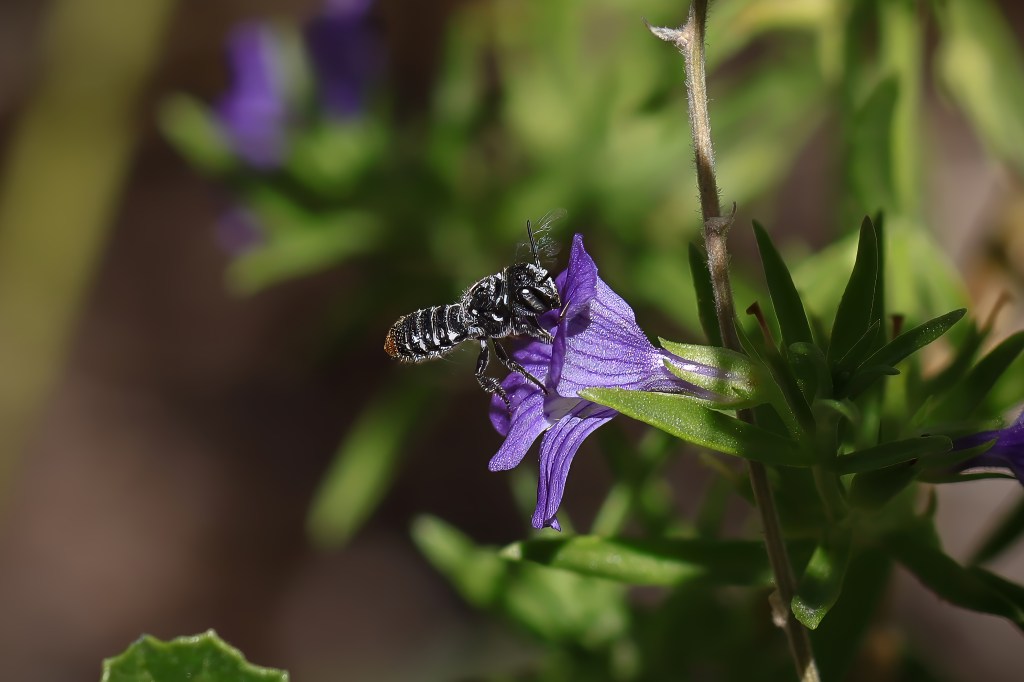
My recent PhD study on an Australian native solitary bee, Megachile tosticauda, challenges a longheld assumption in insect biology: that all bees rely on a functional gut microbiome.
Today I’m going to attempt the impossible – summarising my entire PhD in one blog post.
Honey bees have socially acquired microbiomes
Often when we picture bees, we imagine honey bees – highly social insects with complex relationships not just with each other, but also with the microbes (such as bacteria) living in their gut. Inside the gut of a single honey bee lives one billion gut bacteria, which are essential for digestion, immune function, and protection against disease.
Honey bees live in dense colonies where individuals constantly interact with each other. Every social interaction, such as mouth to mouth feeding (trophallaxis) and contact with shared living quarters, provide reliable transmission pathways for gut bacteria to pass down from one generation to the next. Over millions of years of co-evolution, this has led to stable and highly specific microbial communities that are critical to honey bee health.
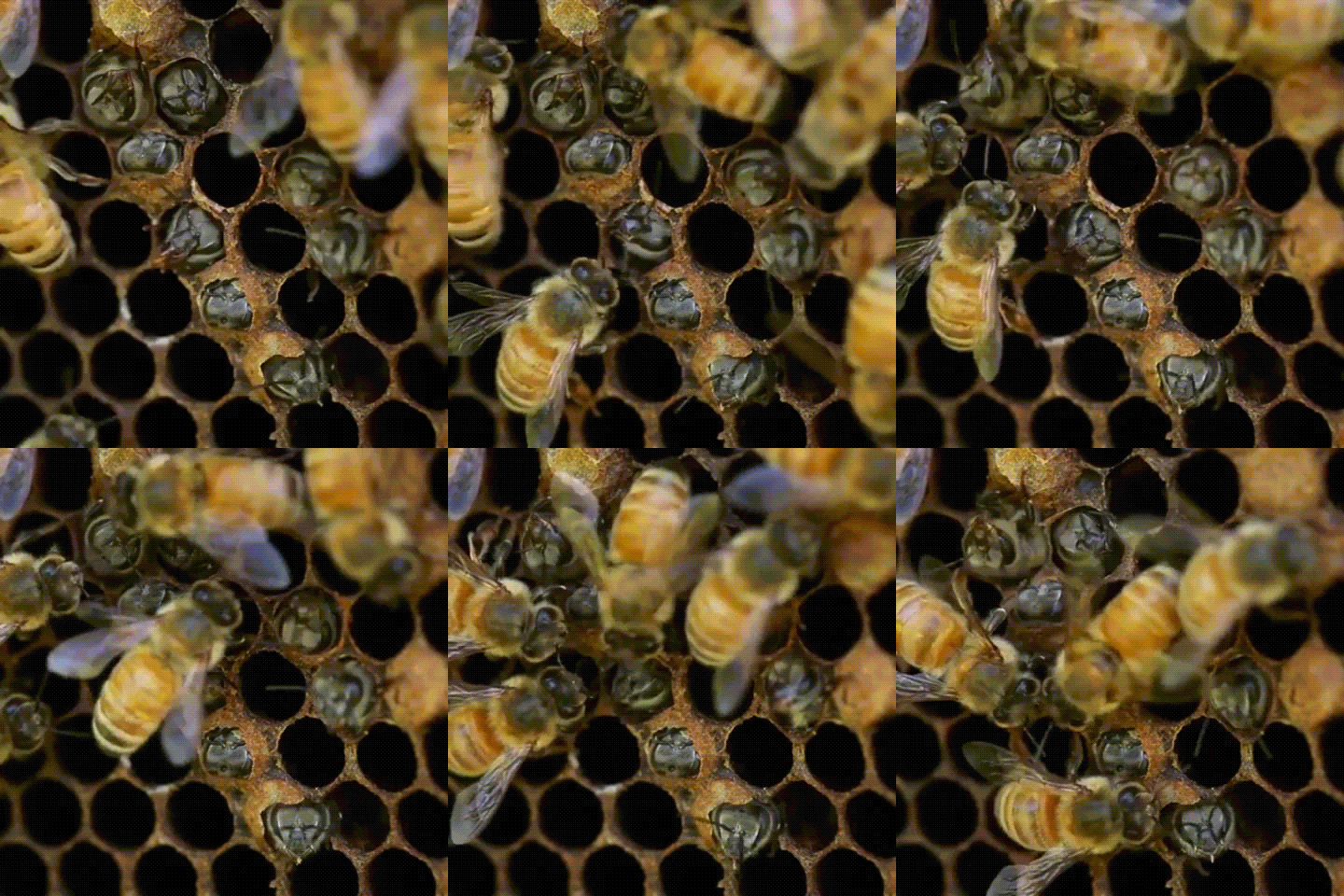
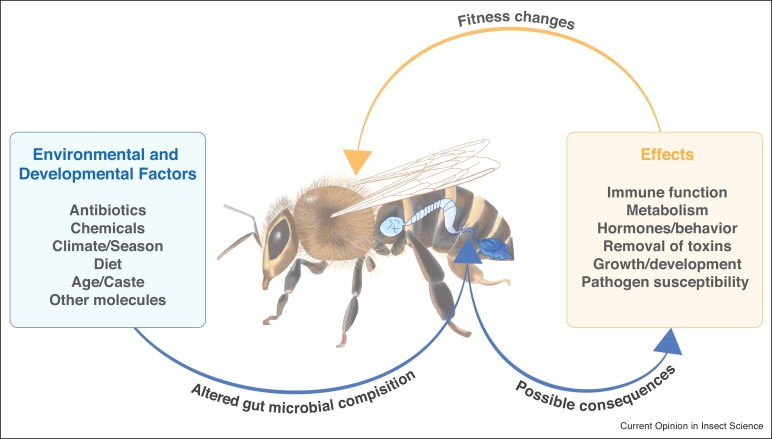
Left: Nurse honey bees can be seen feeding juveniles via trophallaxis. Right: An overview of the role of gut bacteria, taken from Raymann, K. and Moran, N.A., 2018. The role of the gut microbiome in health and disease of adult honey bee workers. Current opinion in insect science, 26, pp.97-104.
Social bees vs solitary bees
But honey bees and their social lifestyle are the exception – not the rule. More than 90% of bee species are solitary, and we do not know whether microbes play a similarly vital role in their biology.
Solitary bees live very differently. Each female builds her own nest, provisions it with food, lays her eggs, and leaves. There is no social care, and no obvious way to pass microbes from one generation to the next, like the socially mediated inheritance of bacteria in honey bees. Yet DNA-based studies in America and Europe have still detected bacteria in solitary bees, leading to the question: Are bacteria important to solitary bees?
Australian solitary resin bee Megachile tosticauda
For my PhD research, I investigated the Australian solitary resin bee M. tosticauda. My first task was to describe the bacterial communities associated with each life-stage (larvae, prepupae, and adults) and in their food, known as pollen provisions, made entirely out of eucalyptus pollen and nectar from native flowers.
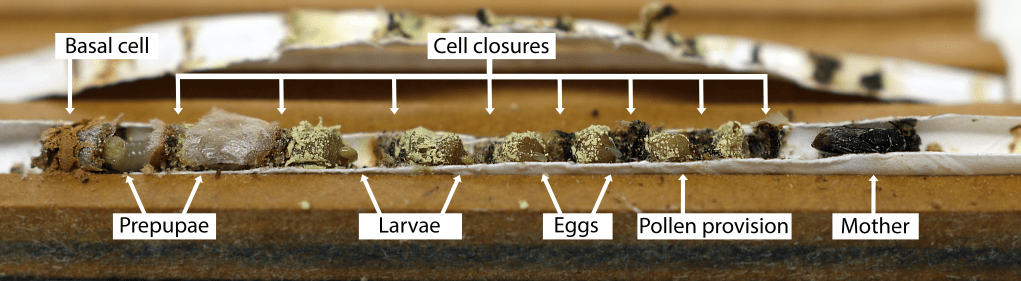
An opened nest of native solitary resin bee Megachile tosticauda. The provisioning mother has built this nest from left to right, using materials such as mud and resin to build the walls and cells, which are individual rooms for each of her offspring. For every cell, the mother collects and prepares all the food her offspring will need to develop into an adult.
Read more about the life cycle, nesting behaviour and diet of M. tosticauda here
The bacterial community associated with Megachile tosticauda
Describing the bacterial communities involved careful sampling, so as not to introduce contamination (bacteria are everywhere!), DNA extractions, PCR amplification at the 16S rRNA gene (used to for bacterial identification), followed by sequencing.
Bacterial community composition differed significantly across developmental stages. Adult bees and fresh pollen provisions were dominated by Acinetobacter, a common nectar-associated taxon. In contrast, older larvae, prepupae, and frass were dominated by Tyzzerella, a genus previously reported in other immature bee systems.
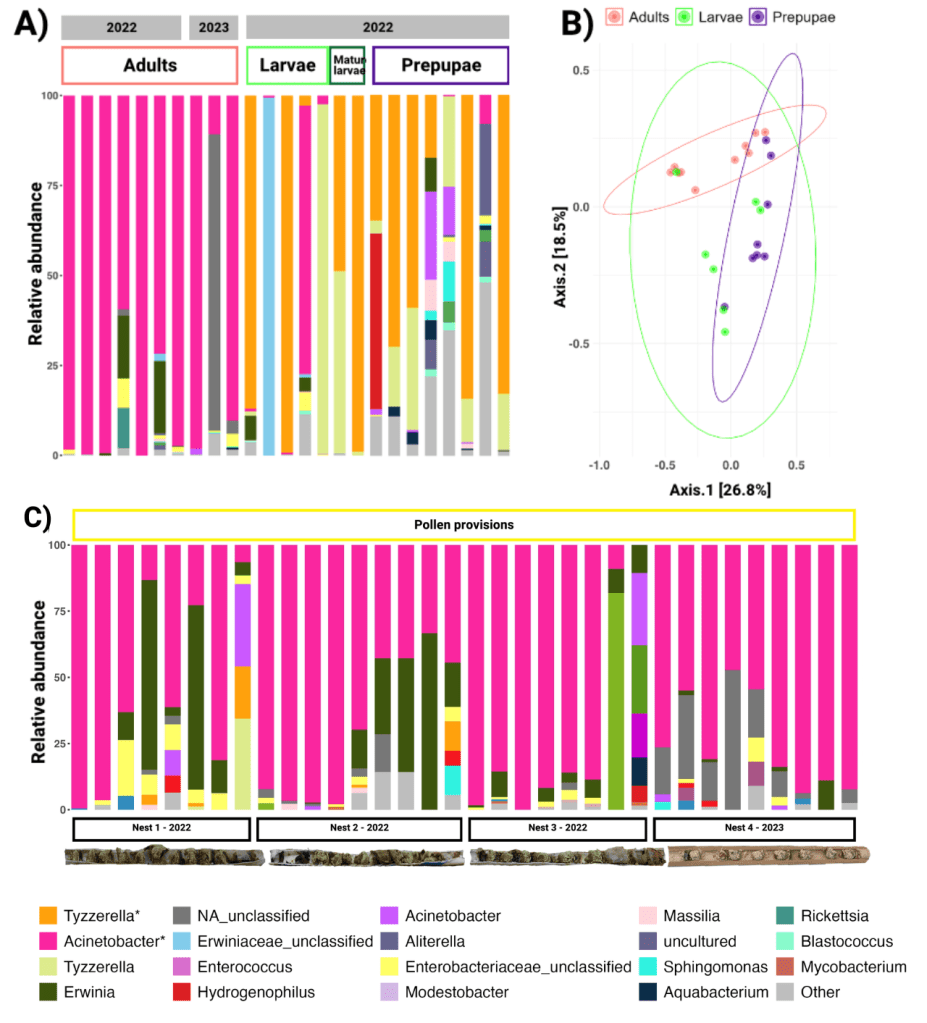
The bacterial community found in Megachile tosticauda adults, larvae, prepupae, and pollen provisions. Each bar represents the one whole sample, and the relative abundance measures the proportion of a bacterial taxon compared to the total population in a sample.
Read more about the bacterial community associated with M. tosticauda here
Testing the role of bacteria
Importantly, DNA presenceFunction, and I needed to use several lines of evidence to move beyond DNA detection and test whether bacteria were beneficial symbionts.
The Antibiotic Feeding Experiment
I tested whether bacteria were important for bee development, by rearing larvae of M. tosticauda on pollen provisions treated with antibiotics that inhibited any bacterial growth. The survival and development of antibiotic-treated larvae were compared to controls.
The result: Removing bacteria from larval food and the gut had no significant effect on survival or final body weight.
Microscopy of Adult Guts
I also used scanning electron microscopy to look directly inside the guts of adult bees and see whether bacteria were physically present in the gut tissues.
The result: Unlike honey bees (used as a positive control), M. tosticauda showed no bacterial colonisation anywhere in the gut.
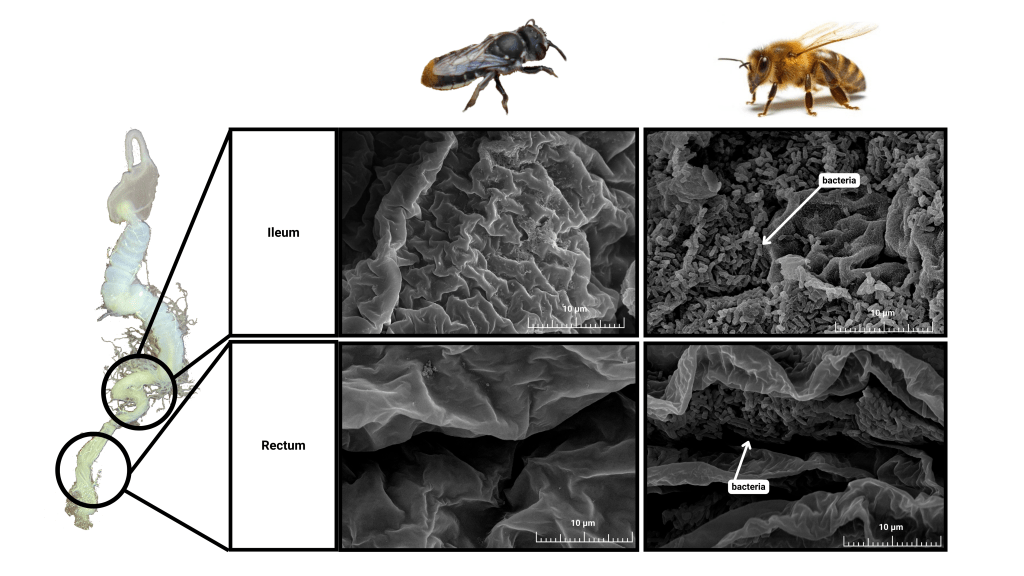
Scanning electron microscopic images taken of the adult gut of M. tosticauda (left) and honey bees (right).
Acquisition experiment
I conducted an experiment to investigate how bacteria are acquired in adults, and whether they might be indirectly inherited form the nest. This involved rearing M. tosticauda in controlled conditions either inside their nest, or inside sterile chambers, and comparing the bacterial communities between the reared bees and natural, wild bees.
The result: The bacterial communities harboured by adults depended on what they had come into contact with; they were environmentally acquired rather than inherited.
So Where Do the “Bacteria” Come From in Megachile tosticauda samples?
There was a very confusing portion of my PhD where I kept asking myself “If these bees don’t host a functional gut microbiome, why does bacterial DNA keep showing up? ”
The answer lies in an important distinction that is often overlooked: Not all detected bacteria are symbionts. My study proposes that most bacterial DNA associated with M. tosticauda are:
- Transient bacteria – picked up from the environment such as from flowers or nest materials, and are passing through the gut or are stuck to the body. These bacteria do not live inside the bee.
- Relic DNA – genetic material from dead bacteria that can still be amplified and sequenced
- Nest commensals – environmental microbes residing in nest materials (such as resin, mud, or pollen provisions) that may provide indirect benefits, for example by inhibiting pathogen growth within the nest environment
DNA sequencing alone cannot tell these apart.
Read more about the evidence toward M. tosticauda not having a gut microbiome
Rethinking the “Bee Microbiome” Concept
Detecting bacterial DNA does not automatically mean a functional microbiome exists. Yet increasingly, this assumption is made. This study cautions against over-interpreting sequencing data, particularly in low-biomass organisms where transient bacteria, relic and off-target DNA can dominate sequencing results.
Read my systematic literature review on how contamination impacts insect microbiome studies, and the need for universal control measures
For honey bees, bacteria are essential partners. For M. tosticauda, bacteria appear to be incidental hitchhikers.
These findings reinforce the idea that sociality is a key driver of stable, co-evolved microbiomes. Without consistent social transmission, long-term bacterial partnerships may fail to establish or persist.
That doesn’t make solitary bees “microbe-free” in a literal sense – but it does mean that their biology does not depend on gut-resident bacteria in the way we see in social bees.
The Takeaway
Not all bees are built the same and neither are their relationships with microbes. For M. tosticauda, bacteria appear to be passengers, not partners. This challenges assumptions based on honey bees and reminds us that nature rarely offers one-size-fits-all solutions.
Solitary bees are important pollinators, yet we are seeing a word wide decline in bee density and diversity. To aid conservation efforts, understanding what bees don’t need is just as important as understanding what they do need. These distinctions can be critical when assessing threats such as habitat change and agrochemical pollution (including antibiotics and pesticides).

 Invertebrate Systematics and Biodiversity Lab
Leave a comment